Every English teacher knows how important it is to have a good dictionary. Students whose first language is not English can have difficulty with slang, jargon and new usage of existing words.
They can try looking up words in a dictionary, but an older dictionary may not be any help.
I was pleased to read that the McQuarie Dictionary, Australia's National Dictionary, is running an on-line poll allowing readers to select their new word of the year for 2007 from the words which the dictionary has just included fpr the first time.
My favourites are:
arse antlers - a tattoo just above the buttocks, having a central section and curving extensions on each side.
floordrobe - a floor littered with discarded clothes, viewed ironically as a clothing storage system.
tart fuel - wine coolers and alcopops, viewed by men as deceptively alcoholic drinks that will lower a woman's resistance to sexual advances.
Another one which I need to watch out for is boomeritis - the range of sports-related injuries incurred by baby boomers as they pursue health and physical fitness programs into their old age, such as bursitis, tendonitis, sprains, strains and stress fractures.
The full list is here.
I hope that Angela is reading, I would like her perspective on this as an Australian.
Sunday, January 13, 2008

Sunday, January 06, 2008
Fame at last!
Happy New Year to everyone, particularly Arno, my faithful reader.
I was surprised and delighted to receive e-mail from an editor at Schmap.com, an online tourist guide. They were looking for pictures for the latest edition of their guide to Prague, and asked if they could use one of the pictures on my Flickr site.
I said that they could, and the picture is now linked in their guide.
OK, it's hardly a commission from National Geographic, but it's better than no recognition at all.
I was surprised and delighted to receive e-mail from an editor at Schmap.com, an online tourist guide. They were looking for pictures for the latest edition of their guide to Prague, and asked if they could use one of the pictures on my Flickr site.
I said that they could, and the picture is now linked in their guide.
OK, it's hardly a commission from National Geographic, but it's better than no recognition at all.
Saturday, December 22, 2007
I almost forgot
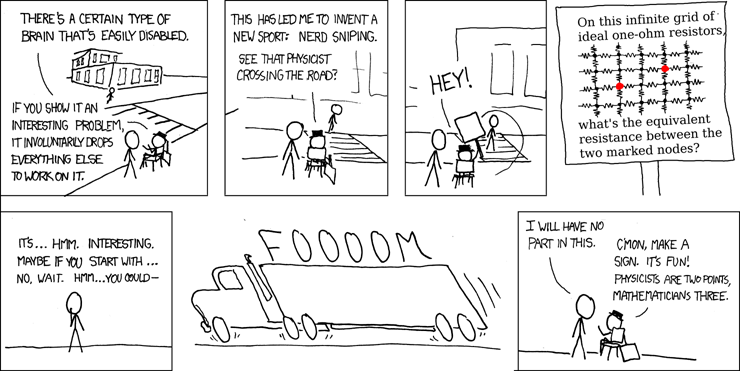
One of the reasons that some people procrastinate is that they are easily distracted by things which are more interesting than the task in hand.
I really loved this cartoon - see the original site here.
Procrastination
I intended to write this piece last weekend...
There was an article in last week's New Scientist about procrastination, and about a scientist called Piers Steel at the University of Calgary in Alberta, Canada who has spent the last ten years studying why people procrastinate. I was delighted when I read that he intends to publish his work, but hasn't got around to it yet.
He does give some tips to help people who procrastinate. I reproduce them here in the hope that they will be of help to someone, possibly me.
Merry Christmas and Happy New Year to my readers, if I have any readers. I will write more in the New Year when I get around to it.
There was an article in last week's New Scientist about procrastination, and about a scientist called Piers Steel at the University of Calgary in Alberta, Canada who has spent the last ten years studying why people procrastinate. I was delighted when I read that he intends to publish his work, but hasn't got around to it yet.
He does give some tips to help people who procrastinate. I reproduce them here in the hope that they will be of help to someone, possibly me.
- Make a firm commitment to your boss or partner to finish a task by a certain time. This will make delays more embarrassing and difficult to cover up.
- Strip your workspace of all distractions, from your iPhone to your Xbox. Then turn off the "ding" on your email. "We have all these temptations," says Steel. "We’ve made our world motivationally toxic."
- Many people say that they put things off because they are too tired to deal with them, so get a good night's sleep and try tackling the most unpleasant and difficult tasks early in the day.
- Set a series of realistic goals. Some counsellors and therapists recommend drawing up weekly, daily or even hourly goals. The more readily sidetracked you are, the more you need to divide your main task into smaller chunks.
- Promise yourself a reward for each goal that you meet.
- Believe in yourself. "The old saying is true," says Steel. "Whether you believe you can or believe you can't, you are probably right."
- Outsource your motivation. Get someone else to regularly goad you into action.
Merry Christmas and Happy New Year to my readers, if I have any readers. I will write more in the New Year when I get around to it.
Thursday, December 13, 2007
For the linguists
I had to chuckle when I saw this cartoon.
So what else has been happening? We had the inspection at the college, and got through OK. I was one of just two part-timers who were observed by the inspector. I think I must attract them like a magnet.
We're looking forward to Christmas now, but I did most of my shopping the easy way over the Internet.
There are two more lessons next week before the Christmas break. I will try to provide something fun and Christmas-based.
I was saddened today to read that Terry Pratchett has early-onset Alzheimers. Not sure what else to say about it, but it doesn't sound good.
So what else has been happening? We had the inspection at the college, and got through OK. I was one of just two part-timers who were observed by the inspector. I think I must attract them like a magnet.
We're looking forward to Christmas now, but I did most of my shopping the easy way over the Internet.
There are two more lessons next week before the Christmas break. I will try to provide something fun and Christmas-based.
I was saddened today to read that Terry Pratchett has early-onset Alzheimers. Not sure what else to say about it, but it doesn't sound good.
Thursday, November 08, 2007
Higher or lower?
I didn't know whether to laugh, cry or just shake my head when I read the linked story.
Camelot, the UK National Lottery operator recently launched a new scratchcard lottery called Cool Cash.
I'm amazed at the lady's tone of indignation, and the fact that she feels that she is being fobbed off.
Camelot have withdrawn the competition as they have other customers who are similarly confused.
Most of the comments posted regarding this story on the newspaper site were very scathing towards the woman. I just feel sad that someone could go right through the British school system and not come out with at least enough numeracy to cope with negative numbers. Given the high levels of personal debt in the country it is worrying.
On the other hand a company which runs lotteries is really dependent on a market which isn't too strong in its ability to calculate. If everyone properly appraised their chances of winning before buying a ticket their sales would probably be much lower.
Camelot, the UK National Lottery operator recently launched a new scratchcard lottery called Cool Cash.
To qualify for a prize, users had to scratch away a window to reveal a temperature lower than the figure displayed on each card. As the game had a winter theme, the temperature was usually below freezing.
But the concept of comparing negative numbers proved too difficult for some Camelot received dozens of complaints on the first day from players who could not understand how, for example, -5 is higher than -6.Tina Farrell, from Levenshulme, called Camelot after failing to win with several cards.
The 23-year-old, who said she had left school without a maths GCSE, said: "On one of my cards it said I had to find temperatures lower than -8. The numbers I uncovered were -6 and -7 so I thought I had won, and so did the woman in the shop. But when she scanned the card the machine said I hadn't."
I phoned Camelot and they fobbed me off with some story that -6 is higher - not lower - than -8 but I'm not having it. "I think Camelot are giving people the wrong impression - the card doesn't say to look for a colder or warmer temperature, it says to look for a higher or lower number. Six is a lower number than 8. Imagine how many people have been misled."
I'm amazed at the lady's tone of indignation, and the fact that she feels that she is being fobbed off.
Camelot have withdrawn the competition as they have other customers who are similarly confused.
Most of the comments posted regarding this story on the newspaper site were very scathing towards the woman. I just feel sad that someone could go right through the British school system and not come out with at least enough numeracy to cope with negative numbers. Given the high levels of personal debt in the country it is worrying.
On the other hand a company which runs lotteries is really dependent on a market which isn't too strong in its ability to calculate. If everyone properly appraised their chances of winning before buying a ticket their sales would probably be much lower.
Friday, November 02, 2007
Observation
The college where I teach my evening class is due to be inspected by Ofsted (The Office of Standards in Education) sometime this term, so they hired a consultant to perform mock inspections this week.
We were all given a briefing before half-term on making sure that we have detailed lesson plans and have all our paperwork up to date for this week. My Monday class started at 6:45pm and I had just got the students settled down when the consultant knocked on the door. She apologised and said that she thought the class started at 7:00. I said it was no problem, ushered her to a seat and talked her quickly through my paperwork.
She read through my plan, looked at her notes and looked puzzled. She had been directed to the wrong class. I was a bit concerned. Once I was geared up to be observed I would rather get it over with than put it off until Wednesday. Luckily she decided to change her plan and observe my class instead.
The observation went well enough, with some areas for me to focus on, but she was generally pleased with the way the students participated.
I can now look forward to my official observation from the head of department in two weeks, and then the Ofsted inspectors some time after that.
Note to my teaching friends in Prague, your administrative burden is light!
We were all given a briefing before half-term on making sure that we have detailed lesson plans and have all our paperwork up to date for this week. My Monday class started at 6:45pm and I had just got the students settled down when the consultant knocked on the door. She apologised and said that she thought the class started at 7:00. I said it was no problem, ushered her to a seat and talked her quickly through my paperwork.
She read through my plan, looked at her notes and looked puzzled. She had been directed to the wrong class. I was a bit concerned. Once I was geared up to be observed I would rather get it over with than put it off until Wednesday. Luckily she decided to change her plan and observe my class instead.
The observation went well enough, with some areas for me to focus on, but she was generally pleased with the way the students participated.
I can now look forward to my official observation from the head of department in two weeks, and then the Ofsted inspectors some time after that.
Note to my teaching friends in Prague, your administrative burden is light!
Healthy Eating
Most people in our team at work do their own thing at lunchtime, so the "team breakfast" at about 9am is the main social event of the day. This morning one of the team bought a carton of milk from the cafeteria to put in the fridge in our break area.
The lady at the servery offered him skimmed or semi-skimmed. "Have you got whole milk?" he said. "No, we don't sell it, it's bad for you" she replied. That may be so, but the breakfast selection contained such healthy low-fat delights as bacon, sausages, fried bread, fried eggs and black pudding. Let's hope they don't take those off the menu any time soon.
Yes, I did read the reports this week that bacon, sausages, red meat and alcohol are sure-fire lethal agents. I'm sure I'll survive them in moderation.
The lady at the servery offered him skimmed or semi-skimmed. "Have you got whole milk?" he said. "No, we don't sell it, it's bad for you" she replied. That may be so, but the breakfast selection contained such healthy low-fat delights as bacon, sausages, fried bread, fried eggs and black pudding. Let's hope they don't take those off the menu any time soon.
Yes, I did read the reports this week that bacon, sausages, red meat and alcohol are sure-fire lethal agents. I'm sure I'll survive them in moderation.
Tuesday, October 16, 2007
Phrase and Fable
We really enjoyed our trip to Brno last weekend, particularly the Burčak walk from Mutěnice. The weather, walk, company and Burčak were excellent. We had some adventures on the trains getting there and back, of which I hope to write more when I get some time.
On Sunday, as we were strolling through Brno and talking, the topic turned to English words or phrases which sound odd to the language student.
Jay mentioned that one student was puzzled by the term "drinking a toast" and asked if this was the same word as the toast which we had for breakfast. He explained that it was.
I mentioned that he could have gone on to explain the origin of the phrase, when people used to put pieces of spiced toast into the wine-cup.
Later we were all discussing the fact that on Saturday's walk we saw a lot of people were carrying branches of various kinds (including marijuana allegedly). I asked of this was a tradition, but none of our Czech friends was sure. I also wondered if it was related to the fact that in ancient times a bush hanging above the doorway indicated wine on sale. "Hence the phrase 'A Good Wine Needs no Bush'", I said. Sue in particular was convinced that I was making this up. I referred her to Brewer's dictionary of Phrase and Fable, of which there is an online edition here.
To support my case that I remember, rather than invent, these things, here is Dr Brewer's take on Good Wine needs no Bush.
So if you are ever looking for the origin of a word or phrase, try looking in Brewer. For completeness, below is the good doctor's entry on drinking a toast.
To next year's Burčak trip!
On Sunday, as we were strolling through Brno and talking, the topic turned to English words or phrases which sound odd to the language student.
Jay mentioned that one student was puzzled by the term "drinking a toast" and asked if this was the same word as the toast which we had for breakfast. He explained that it was.
I mentioned that he could have gone on to explain the origin of the phrase, when people used to put pieces of spiced toast into the wine-cup.
Later we were all discussing the fact that on Saturday's walk we saw a lot of people were carrying branches of various kinds (including marijuana allegedly). I asked of this was a tradition, but none of our Czech friends was sure. I also wondered if it was related to the fact that in ancient times a bush hanging above the doorway indicated wine on sale. "Hence the phrase 'A Good Wine Needs no Bush'", I said. Sue in particular was convinced that I was making this up. I referred her to Brewer's dictionary of Phrase and Fable, of which there is an online edition here.
To support my case that I remember, rather than invent, these things, here is Dr Brewer's take on Good Wine needs no Bush.
Good Wine needs no Bush
It was customary to hang out ivy, boughs of trees, flowers, etc., at public houses to notify to travellers that “good cheer” might be had within.
“Some ale-houses
upon the road I saw,
And some with bushes showing they wine did
draw.”
Poor Robin’s Perambulations (1678).
So if you are ever looking for the origin of a word or phrase, try looking in Brewer. For completeness, below is the good doctor's entry on drinking a toast.
To next year's Burčak trip!
Toast
A name given, to which guests are invited to drink in compliment. The name at one time was that of a lady. The word is taken from the toast which used at one time to be put into the tankard, and which still floats in the loving-cup, and also the cups called copus, bishop, and cardinal, at the Universities. Hence the lady named was the toast or savour of the wine—that which gave the draught piquancy and merit.
The story goes that a certain beau, in the reign of Charles II., being at Bath, pledged a noted beauty in a glass of water taken from her bath; whereupon another roysterer cried out he would have nothing to do with the liquor, but would have the toast—i.e. the lady herself. (Rambler, No. 24.)
“Let the toast pass, drink to the lass.”—Sheridan: School for Scandal.
“Say, why are beauties praised and honoured most,The wise man’s passion and the
vain man’s toast.” Pope: Rape of the Lock, canto i.
Thursday, October 04, 2007
Fifty Years of the Space Age
Fifty years ago this evening, Sputnik 1, the first artificial satellite was launched, and changed the world.
That first mission can be seen as little more than a propaganda coup, and many people are dismissive of the benefits of space flight, particularly manned flight. On the other hand, satellites have brought huge benefits in communications and navigation as well as in the understanding and management of earth resources.
I believe that the space programmes have provided us with a great technological stimulus, and given us with huge benefits. I wish I could be as confident that the next fifty years will bring about technological changes as great as those we have seen in the last fifty, but let's try to be optimistic.
That first mission can be seen as little more than a propaganda coup, and many people are dismissive of the benefits of space flight, particularly manned flight. On the other hand, satellites have brought huge benefits in communications and navigation as well as in the understanding and management of earth resources.
I believe that the space programmes have provided us with a great technological stimulus, and given us with huge benefits. I wish I could be as confident that the next fifty years will bring about technological changes as great as those we have seen in the last fifty, but let's try to be optimistic.
Tuesday, September 25, 2007
The Man With Two Jobs
I have been back in the UK for two months, and I have been working as an IT contractor for five weeks. I figured that it would be nice to do more teaching sometime, but haven't been looking for work.
I was surprised and delighted when I had a call from the local college asking me if I wanted to teach an evening class. The college staff knew I was back in the country when I asked for a reference, and they must have thought I did a good job on last year's Sumer School.
I start tomorrow with an Elementary class. I met them briefly yesterday evening and I'm looking forward to teaching them tomorrow.
The day job? They have a flexi-time scheme so I can leave early for college on Monday and Wednesday and make up time during the rest of the week.
It's going to be a busy time, but I'm excited!
I was surprised and delighted when I had a call from the local college asking me if I wanted to teach an evening class. The college staff knew I was back in the country when I asked for a reference, and they must have thought I did a good job on last year's Sumer School.
I start tomorrow with an Elementary class. I met them briefly yesterday evening and I'm looking forward to teaching them tomorrow.
The day job? They have a flexi-time scheme so I can leave early for college on Monday and Wednesday and make up time during the rest of the week.
It's going to be a busy time, but I'm excited!
English Language Opportunity in Prague
I am indebted once again to "The Register" for this story. They report that in a document promoting the Czech Olympic Committee's Olympic Bid, the committee came up with the following gem.
Three times will Prague examine courting with international Olympic collection. Previous two advances arrange games are over always inglorious. A how go in for Twentieth Century typical, capital you-break teeth among others on policy. Historian sport and Olympic motion Francis wheelwright prove this story, which he began write at the end 19. century, tell very attractive.Apparently there is more here. It seems to me that an enterprising school or freelance English teacher might want to approach them and quote a rate to do the job properly.
Friday, September 14, 2007
Textonyms
My former colleague, Alec Muffet has written in his blog about Qwertonyms, words which are different, but use the same keys in predictive text mode on a mobile phone, eg 'home' and 'good'.
I first heard about them a few years ago. Some friends texted to say they were coming over, and I replied with "I'll open the post", which confused them. I meant port
When I explained my puzzling reply, my friend told me that Stephen Fry had spoken about them. His nephew and his friends had started using the word 'book' instead of 'cool', because when they typed 'cool' in the phone 'book' was the first entry in the list. Book became their slang for cool not just in text but in speech as well.
The word textonyms, rather than qwertonyms, has been used to describe these.
The Chambers Dictionary website has an entry for textonym in its wordwatch section - http://www.chambersharrap.co.uk/chambers/features/wordwatch/textonym.shtml
I first heard about them a few years ago. Some friends texted to say they were coming over, and I replied with "I'll open the post", which confused them. I meant port
When I explained my puzzling reply, my friend told me that Stephen Fry had spoken about them. His nephew and his friends had started using the word 'book' instead of 'cool', because when they typed 'cool' in the phone 'book' was the first entry in the list. Book became their slang for cool not just in text but in speech as well.
The word textonyms, rather than qwertonyms, has been used to describe these.
The Chambers Dictionary website has an entry for textonym in its wordwatch section - http://www.chambersharrap.co.uk/chambers/features/wordwatch/textonym.shtml
Identifying Bears
I guess this is doing the rounds, but I thought it was funny.
In light of the rising frequency on human/grizzly bear conflicts, the Alaska Department of Fish and Game is advising tourists, hikers, and fishermen to take extra precautions and keep alert for bears while travelling this summer.
We advise that people wear noisy little bells on their clothing so as not to startle bears that are not expecting them. We also advise everyone to carry pepper spray with them in case of an encounter with a grizzly.
It is also a good idea to watch out for fresh signs of bear activity.
Outdoorsmen should recognize the difference between black bear and grizzly bear dung. Black bear dung is smaller and contains lots of berries and squirrel fur.
Grizzly bear dung has little bells in it and smells like pepper.Don't forget, you don't have to outrun the bear, you just have to outrun your fellow hikers!
Czech falls off motorbike, wakes up with British accent
I saw this story at The Register. A Czech speedway rider racing in England came off his bike and was concussed. When he came around he asked where he was, in perfect English. According to the story he couldn't speak much English prior to the accident, and reverted to this state two days later. Read the story for more details.
I guess the moral of this story is that all it takes to sound like an upper-class Englishman is a blow to the head.
I hope this doesn't mean that English teachers in Prague start taking blunt instruments into class, though.
I guess the moral of this story is that all it takes to sound like an upper-class Englishman is a blow to the head.
I hope this doesn't mean that English teachers in Prague start taking blunt instruments into class, though.
Tuesday, September 11, 2007
Michael Jackson is dead
No, not the American singer! I was saddened to learn on Friday that Michael Jackson, the authority on beers of the world, dies recently. The Telegraph has an obituary.
I saw his TV series "The Beer Hunter" in 1990, and learned of the rich variety of beers that were made in Belgium, Germany and Czechoslovakia. There was a discussion of his work on the radio on Friday in which he was credited with stimulating the boom in microbreweries in the US.
His contribution to the well-being of the world will be sadly missed.
I saw his TV series "The Beer Hunter" in 1990, and learned of the rich variety of beers that were made in Belgium, Germany and Czechoslovakia. There was a discussion of his work on the radio on Friday in which he was credited with stimulating the boom in microbreweries in the US.
His contribution to the well-being of the world will be sadly missed.
Tour of Britain
I missed the start of the Tour de France in London this year because I was still in the Czech Republic. It's a shame because I enjoy cycle racing and the London start was a great spectacle, even if the Tour was somewhat tarnished by the finish.
On Sunday the Tour of Britain started with a Prologue time-trial at Crystal Palace. This is a much lower-key event, lasting just seven days and with mostly minor teams and development squads rather than the stars of the ProTour teams.
Still, I enjoyed watching it, and it was great to see aBritish rider, Mark Cavendish of T-Mobile win on the day, with a number of other britons doing well. This was a big change from when I used to watch the Milk Race in the early 1980s.
In those days the race was an amateur event and young British hopefuls struggled to compete with young riders from Belgium and Holland who were preparing for pro careers, and fully mature riders from Eastern Europe who were employed by state organisations but were able to race more or less full-time. The prospect of a British winner in those days was less likely than a British winner at Wimbledon. Nowadays British riders are dominant in track events and we have some riders in the pro teams who can hold there own.
Mark Cavendish is in his first full season. He went on from the prologue to win yesterday's stage, too. He has won 10 1-day races and stages so far, and he should go on to greater achievements next season. I sincerely hope that cycling is able to keep root out doping and ensure that the new crop of riders can reach their full potential without drugs.
On Sunday the Tour of Britain started with a Prologue time-trial at Crystal Palace. This is a much lower-key event, lasting just seven days and with mostly minor teams and development squads rather than the stars of the ProTour teams.
Still, I enjoyed watching it, and it was great to see aBritish rider, Mark Cavendish of T-Mobile win on the day, with a number of other britons doing well. This was a big change from when I used to watch the Milk Race in the early 1980s.
In those days the race was an amateur event and young British hopefuls struggled to compete with young riders from Belgium and Holland who were preparing for pro careers, and fully mature riders from Eastern Europe who were employed by state organisations but were able to race more or less full-time. The prospect of a British winner in those days was less likely than a British winner at Wimbledon. Nowadays British riders are dominant in track events and we have some riders in the pro teams who can hold there own.
Mark Cavendish is in his first full season. He went on from the prologue to win yesterday's stage, too. He has won 10 1-day races and stages so far, and he should go on to greater achievements next season. I sincerely hope that cycling is able to keep root out doping and ensure that the new crop of riders can reach their full potential without drugs.
Monday, August 20, 2007
The Fight For English
Browsing through Waterstone's bookshop the other day I noticed that David Crystal has written a counterblast to Lynne Truss's "Eats, Shoots and Leaves" entitled "The Fight for English: How Language Pundits Ate, Shot, and Left".
Crystal has written about the book in the Guardian.
I am a great admirer of Crystal. When I was studying for my CELTA his book "Rediscover Grammar" saved me from becoming an insufferably pedantic prescriptivist* . I was privileged to hear him speak at Westminster University last summer when a friend of mine invited me to a linguistics conference there.
I haven't yet ordered a copy of the book, but I have a paycheck on the way very soon, and my basket at Amazon is filling up.
*I can still be insufferably pedantic on occasion, but only in unarguable matters of fact.
Crystal has written about the book in the Guardian.
I am a great admirer of Crystal. When I was studying for my CELTA his book "Rediscover Grammar" saved me from becoming an insufferably pedantic prescriptivist* . I was privileged to hear him speak at Westminster University last summer when a friend of mine invited me to a linguistics conference there.
I haven't yet ordered a copy of the book, but I have a paycheck on the way very soon, and my basket at Amazon is filling up.
*I can still be insufferably pedantic on occasion, but only in unarguable matters of fact.
Friday, August 03, 2007
It's not Prague's fault!
The British press yesterday made a lot from a Foreign & Commonwealth Office report on the use of consular services by British tourists abroad. Apparently a higher proportion of British visitors to Prague need consular assistance than those in any other foreign destination.
Somehow the stories seemed to imply that there is something dangerous about Prague. I think that gangs of drunken Brits can lose their wallets, phones, clothes etc wherever they happen to be. So many of them do it in Prague because it's a really great place to visit and a half litre of beer is cheaper than most non-alcoholic alternatives.
A follow-up story in today's Guardian lists other places where Brits get into difficulties, and does put Prague into perspective.
Luckily the stag and hen parties didn't make their way to my favourite haunts.
Somehow the stories seemed to imply that there is something dangerous about Prague. I think that gangs of drunken Brits can lose their wallets, phones, clothes etc wherever they happen to be. So many of them do it in Prague because it's a really great place to visit and a half litre of beer is cheaper than most non-alcoholic alternatives.
A follow-up story in today's Guardian lists other places where Brits get into difficulties, and does put Prague into perspective.
I remember one Friday when was catching a lunchtime flight back to the UK for the weekend. I arrived at the airport at about 11:00 and one of the airside bars was full of Brits from a stag weekend. This really puzzled me, I figured that they had got straight off the plane and gone into the first bar they saw, before they even went through passport control. Maybe they were waiting for friends on another flight, or maybe they were on a mission to drink in every bar they saw during their time in Prague."I don't know whether the Czech Republic is more dangerous than anywhere else," says Frances Tuke of ABTA. "I think the thing is that we can be a danger to ourselves, particularly when cheap booze and - shall we say - other cheap services are so readily available."
A 2004 report by the Czech tourism office found that local police believed 20% of all weekend crime in Prague involved British men on stag trips. My colleague Gary confirms this view of events: "My biggest fear when I'm in Prague - I go most years - is that I'm going to get beaten up by a bunch of English people on a stag or hen do."
Luckily the stag and hen parties didn't make their way to my favourite haunts.
Subscribe to:
Posts (Atom)

 Posts
Posts


